
Scouting AI Thought Leaders: How PR Agencies Build Founder Profiles That Get Covered
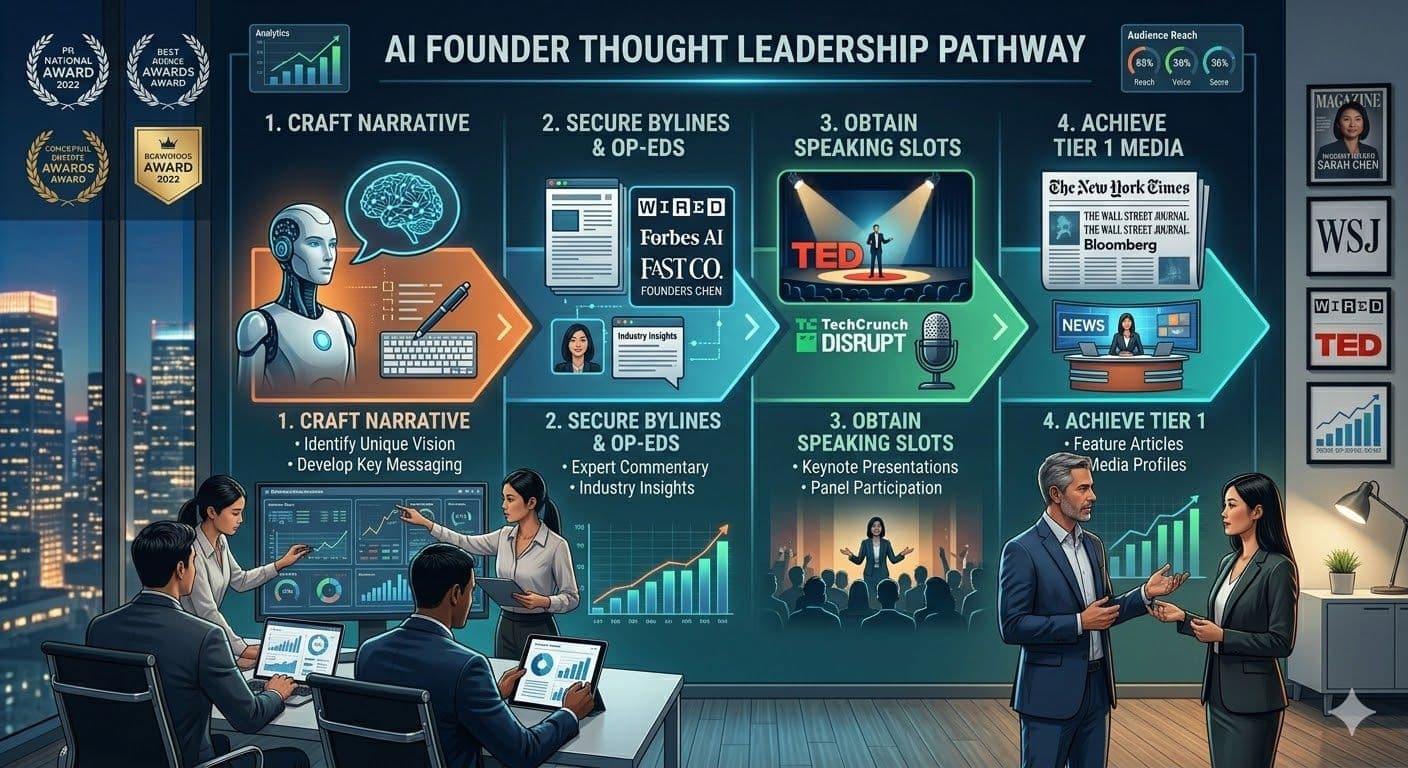
The most-quoted AI founders in the media didn't get there by accident. Behind nearly every "rising voice in AI" profile, every keynote invitation, every byline in Harvard Business Review sits a deliberate PR strategy that took an unknown technical founder and built them into a recognized industry authority.
This matters because in AI — where every company claims breakthrough technology — the founder's personal credibility often determines which company gets covered, funded, and trusted. Journalists rely on familiar expert sources. Conference organizers book speakers with media presence. Investors back founders they've already seen quoted in credible publications.
The founder brand isn't a vanity project. It's an acquisition channel.
The Anatomy of a Founder PR Strategy
Building an AI founder into a thought leader follows a systematic process that most PR agencies break into four stages: narrative development, credibility seeding, media relationship building, and authority compounding.
Stage 1: Narrative development is where most founders go wrong on their own. Technical founders default to explaining what their technology does. But journalists and audiences don't cover technology — they cover stories. The narrative needs to answer a different question: why does this founder's perspective matter right now?
Specialized AI PR agencies approach narrative development by identifying the intersection of the founder's expertise, current market tensions, and media appetite. A computer vision founder isn't interesting because their algorithm is 3% more accurate. They're interesting because they can articulate how visual AI is about to reshape supply chain quality control — and they have the technical authority to back that claim.
The best founder narratives are opinion-forward, slightly contrarian, and anchored in genuine expertise. They give journalists a reason to call that founder first when the topic surfaces again.
Stage 2: Credibility seeding builds the foundation before pursuing major media. This includes securing byline articles in industry publications, placing expert quotes in relevant news stories, and establishing a consistent presence across LinkedIn and industry forums. The goal is ensuring that when a Tier 1 journalist Googles the founder, they find a trail of credible contributions — not an empty profile.
From Unknown to Keynote: The Media Ladder
The path from obscurity to thought leadership follows a predictable media ladder that experienced PR agencies navigate deliberately.
It typically starts with trade and niche publications. For AI founders, that means outlets like VentureBeat, The AI Journal, or sector-specific publications relevant to their application area. These placements are achievable relatively quickly and serve two purposes: they generate searchable credibility, and they establish the founder as a source that journalists at larger outlets can discover and verify.
From there, the strategy escalates to Tier 1 business and technology media. This is where working with a PR agency for AI founders becomes particularly valuable, because securing coverage in outlets like Engadget, Forbes, or BBC requires more than a compelling pitch — it requires pre-existing journalist relationships and an understanding of each outlet's editorial priorities.
The results of this approach are visible in specific examples. When AI music company Aimi launched at SXSW, their PR strategy didn't just aim for event coverage — it positioned their founder within the broader narrative of generative AI's impact on creative industries. The Engadget coverage that resulted framed Aimi not as another music tech startup but as a company whose founder was shaping the conversation about AI and creativity. That positioning opened doors for subsequent speaking invitations, follow-up features, and ongoing journalist relationships.
Similarly, Wasteless — an AI company tackling food waste — secured a BBC feature that elevated their founder from a startup CEO into a recognized voice on the intersection of artificial intelligence and sustainability. That single placement reshaped every subsequent conversation with investors, partners, and media.
The Byline Strategy: Writing Authority Into Existence
One of the most underutilized tools in founder PR is the strategic byline. Guest articles published under the founder's name in respected publications create a permanent record of expertise that compounds over time.
The key is that bylines should not be product pitches disguised as thought leadership. Effective bylines take a genuine stance on an industry question. They offer frameworks, challenge conventional wisdom, or provide insider perspective that only someone deeply embedded in the space could articulate.
A specialized AI PR agency typically manages the end-to-end byline process: identifying target publications, developing topic angles that align with editorial calendars, ghostwriting or heavily editing the piece to meet publication standards, and managing the submission and revision process. Most founders don't have the time or editorial experience to manage this independently — and a rejected byline pitch to a major publication can close that door for months.
The compounding effect of a consistent byline strategy is significant. Three to four well-placed bylines over six months — a cadence that a dedicated AI PR partner can maintain consistently — create a body of published work that transforms a founder's Google results, establishes expertise across multiple topic areas, and provides material that sales teams, investors, and conference organizers all reference in their evaluations.
Speaking Engagements: The PR-Conference Feedback Loop
Conference speaking and media coverage exist in a reinforcing loop. Media coverage makes founders more attractive to conference organizers. Speaking engagements generate content and networking opportunities that lead to more media coverage.
PR agencies that understand this loop work both sides simultaneously. They pitch founders for speaking slots at targeted conferences while pursuing media coverage of the founder's conference appearances. They prepare founders with media training, talking points, and presentation coaching that ensures every public appearance reinforces the same narrative.
For AI founders specifically, the conference circuit matters enormously. Events like SXSW, Web Summit, CES, NeurIPS, and industry-specific conferences serve as proving grounds where founders either establish or reinforce their authority. SlicedBrand, for instance, leveraged Aimi's SXSW presence not just for event-day coverage but as a launchpad for sustained media relationships that continued generating coverage long after the event concluded.
The lesson is clear: conferences aren't just networking events — they're media opportunities that experienced PR teams convert into lasting thought leadership assets.
The Long Game: Compounding Authority
Building a genuine thought leader profile isn't a three-month project. The founders who become go-to sources for journalists have typically invested 12-18 months in consistent, strategic PR activity. But the returns compound dramatically.
In the early months, each placement requires significant effort — original pitching, relationship building, narrative refinement. By month twelve, journalists begin reaching out proactively for expert commentary. Speaking invitations arrive unsolicited. Podcast hosts and newsletter writers reference the founder's previous work. The flywheel starts spinning on its own.
This is the stage where PR transitions from a cost center to a genuine competitive moat. When your founder is the recognized voice on your category, competitors can't replicate that advantage regardless of their marketing budget.
Key Takeaways
- AI thought leadership is built systematically through narrative development, credibility seeding, media ladder progression, and authority compounding
- Founder narratives should be opinion-forward and anchored in market tensions — not product descriptions
- Strategic bylines create a permanent, compounding body of published expertise that reshapes how investors, journalists, and partners perceive the founder
- Conference speaking and media coverage create a reinforcing loop — work both channels simultaneously
- Working with a specialized AI PR agency accelerates the process through established journalist relationships and proven playbooks for founder positioning
- The compound effect of consistent PR activity transforms founder visibility from a cost center into a competitive moat within 12-18 months