
Restaurant KOL Strategy: How F&B Opinion Leader Partnerships Drive Customer Traffic
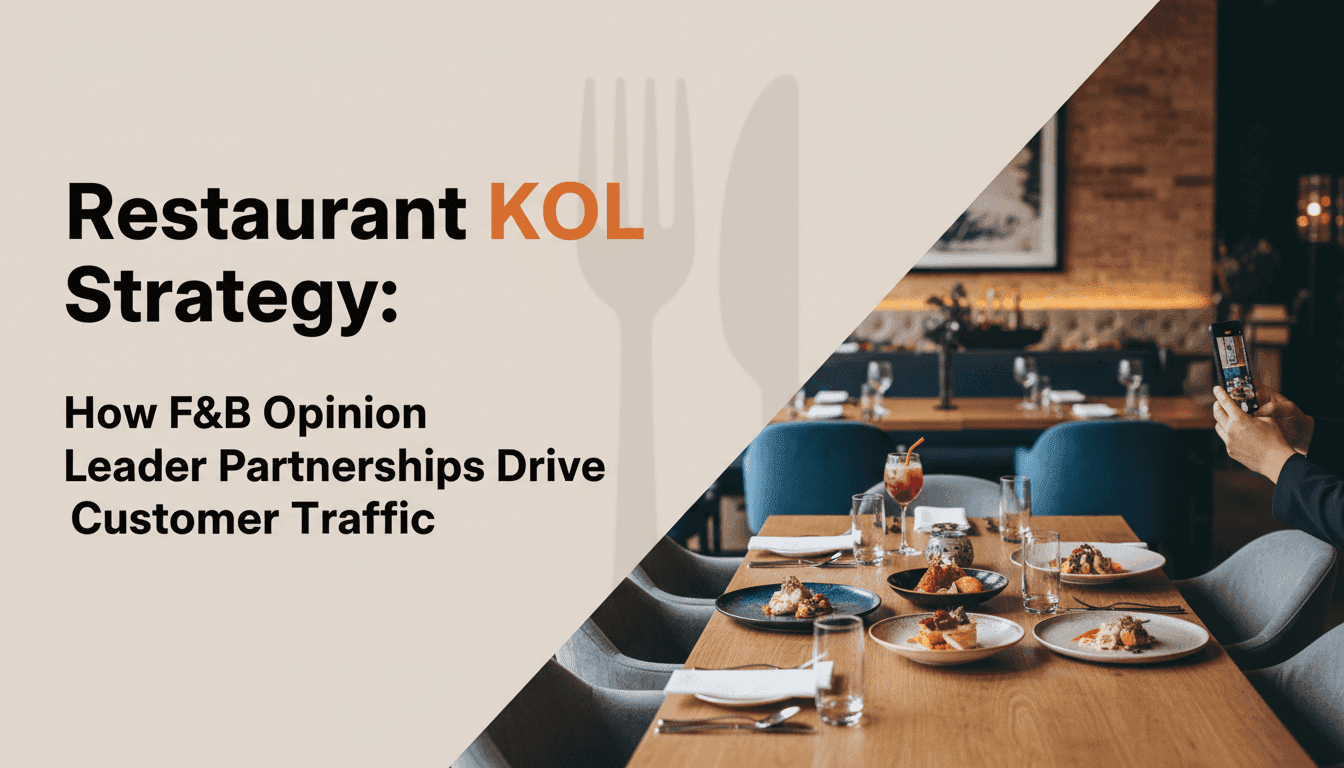
Table Of Contents
- What Makes Restaurant KOL Partnerships Different from Traditional Influencer Marketing
- Why Restaurant Brands Need a Dedicated KOL Strategy
- Types of F&B Opinion Leaders and Their Impact
- Building Your Restaurant KOL Partnership Framework
- Platform-Specific Strategies for Restaurant KOL Campaigns
- How AI Is Transforming Restaurant Influencer Discovery
- Measuring Success: KPIs That Matter for F&B Partnerships
- Common Pitfalls in Restaurant KOL Campaigns
The restaurant industry faces a unique challenge in influencer marketing: diners don't just need to be convinced to buy something online, they need to be motivated to physically show up at your location. This fundamental difference makes restaurant KOL strategy dramatically different from traditional product-based influencer campaigns. When a food blogger with 50,000 followers posts about your new menu, you're not just seeking engagement metrics; you're trying to fill tables during your slowest hours, launch a new location, or establish your brand in a competitive dining scene.
F&B opinion leader partnerships have become essential for restaurants, cafes, bars, and hospitality brands looking to cut through the noise of traditional advertising. Unlike static billboard ads or generic social media posts, a trusted food influencer brings authenticity, visual storytelling, and immediate social proof that resonates with today's experience-driven consumers. The challenge is finding the right KOLs whose audience demographics, content quality, and authentic voice align with your restaurant's brand positioning.
This comprehensive guide explores how modern restaurant brands are building successful KOL strategies, from identifying the right opinion leaders to measuring real-world impact on reservations and foot traffic. You'll discover platform-specific tactics, partnership frameworks, and how AI-powered tools are replacing outdated influencer databases with intelligent discovery systems that understand your brand's unique needs.
Restaurant KOL Strategy
Transform Influencer Partnerships Into Foot Traffic
The Restaurant Marketing Challenge
Unlike e-commerce, restaurants must convert digital engagement into physical visits. 78% of diners discover new restaurants through social media, making KOL partnerships essential for filling tables.
3 Types of F&B Influencers
Macro Influencers
Broad reach for major launches
1-3% engagement
Micro Influencers
The sweet spot for most restaurants
3-8% engagement
Nano Influencers
Hyper-engaged local audiences
High trust & authenticity
5-Step KOL Partnership Framework
Define Your Ideal KOL Profile
Focus on audience demographics, location, engagement rates, and values alignment—not just follower counts.
Discover & Vet Candidates
Use AI-powered tools to scan platforms in real-time for creators whose recent content and audience truly align.
Develop Partnership Models
Structure collaborations: complimentary experiences, paid partnerships, ambassadorships, or event co-hosting.
Create Clear Guidelines
Share brand story and key messaging, but avoid overscripting—authentic voice drives results.
Enable Exceptional Experiences
Brief your team, ensure quality service, and create memorable moments worth sharing authentically.
Platform-Specific Strategies
Stories: Time-sensitive promos
Reels: Viral discovery
Feed: Lasting social proof
TikTok
Authentic, fast-paced content
Trending audio integration
Perfect for Gen Z reach
YouTube
Long-form reviews
Evergreen SEO value
Deeper brand connections
KPIs That Actually Matter
Reservation Tracking
Foot Traffic Analysis
Menu Item Sales Lift
Repeat Customer Rate
Sentiment Analysis
The AI Advantage
Traditional influencer databases are outdated before you search them. Modern AI tools scan platforms in real-time, understanding your needs in plain English.
What Makes Restaurant KOL Partnerships Different from Traditional Influencer Marketing
Restaurant KOL strategy operates in a fundamentally different environment than e-commerce influencer marketing. While an online retailer can ship products globally and convert audiences anywhere, restaurants serve a geographically constrained market. Your ideal food influencer isn't necessarily the one with millions of followers; it's the creator whose engaged audience actually lives within driving distance of your location. This geographic component changes everything about how you approach influencer discovery and partnership evaluation.
The purchase funnel for restaurant marketing is also uniquely compressed. When someone watches an unboxing video for electronics, they might research for weeks before buying. When a trusted food KOL posts a mouth-watering story about your brunch menu on Sunday morning, followers make dining decisions within hours. This immediacy creates both opportunity and risk. A well-timed partnership can fill your restaurant during a typically slow period, while poorly executed collaborations can expose operational weaknesses to thousands of potential customers.
Authenticity matters exponentially more in F&B opinion leader partnerships because food experiences are deeply personal and cultural. Audiences can immediately detect when a food blogger is reviewing a restaurant purely for compensation versus genuinely enjoying the experience. The best restaurant KOL partnerships feel like a friend recommending their new favorite spot, not a paid advertisement. This requires finding creators whose existing content style, cuisine preferences, and dining habits naturally align with what your restaurant offers.
Why Restaurant Brands Need a Dedicated KOL Strategy
The traditional restaurant marketing playbook of print ads, radio spots, and food photography is no longer sufficient in a market where diners discover 78% of new restaurants through social media. Today's consumers, particularly Gen Z and Millennials, trust peer recommendations and influencer content more than traditional advertising. They're searching Instagram for "best pasta in Chicago" and watching TikTok food tours before deciding where to celebrate special occasions. Without a structured restaurant KOL strategy, you're invisible in these critical discovery moments.
Restaurant brands that approach influencer marketing reactively, responding to individual creator requests without strategic planning, typically see inconsistent results and wasted budgets. A dedicated KOL strategy allows you to align influencer partnerships with specific business objectives, whether that's launching a new location, promoting off-peak dining hours, introducing seasonal menus, or establishing your restaurant in a new market segment. Strategic planning ensures every partnership delivers measurable value beyond vanity metrics.
The competitive landscape makes strategic KOL partnerships even more essential. Your competitors are already working with food influencers, and if you're not actively managing these relationships, you're allowing others to dominate the local food conversation. A well-executed F&B opinion leader strategy doesn't just promote your restaurant; it positions your brand within the broader culinary narrative of your city or region. This sustained visibility builds brand equity that translates to customer loyalty and premium pricing power.
Types of F&B Opinion Leaders and Their Impact
Understanding the distinct categories of food and beverage opinion leaders helps you build a diversified partnership portfolio that reaches different audience segments. Macro food influencers (100K+ followers) offer broad reach and can generate significant buzz for major launches or events. These creators often have professional photography teams and produce highly polished content that elevates brand perception. However, their engagement rates typically run lower (1-3%), and their audiences span wide geographic areas that may extend far beyond your service radius.
Micro food influencers (10K-100K followers) represent the sweet spot for most restaurant KOL strategies. These creators maintain strong engagement rates (3-8%), cultivate genuine relationships with their audiences, and often have concentrated local followings. A micro-influencer whose 25,000 followers are primarily young professionals in your neighborhood delivers far more value than a macro-influencer whose 200,000 followers are scattered across the country. Their content feels authentic and relatable, driving actual reservation behavior rather than just awareness.
Nano-influencers (1K-10K followers) and passionate local food enthusiasts shouldn't be overlooked in your restaurant KOL strategy. While their individual reach is limited, their hyper-engaged audiences often trust them implicitly. These creators are typically more accessible for partnerships, require smaller investments, and can be activated at scale. Consider these additional F&B opinion leader categories:
- Food bloggers and critics who maintain long-form content platforms and provide detailed reviews
- Chef influencers whose professional credibility adds authority to restaurant recommendations
- Lifestyle influencers who integrate dining experiences into broader content about city life, dating, or family activities
- Travel content creators who feature restaurants as destination experiences
- Health and wellness influencers who focus on specific dietary approaches (vegan, keto, organic)
The most effective restaurant KOL strategies blend multiple influencer types to achieve different objectives. Macro-influencers drive awareness for grand openings, micro-influencers sustain ongoing conversation and foot traffic, while nano-influencers provide authentic social proof and community building.
Building Your Restaurant KOL Partnership Framework
Successful F&B opinion leader partnerships require structured frameworks rather than ad-hoc collaborations. Begin by defining clear campaign objectives that align with your broader business goals. Are you trying to increase weekend brunch reservations by 30%? Launch a new cocktail menu? Attract a younger demographic? Establish your restaurant as the destination for a specific cuisine? Your objectives determine which KOLs you should target, what content formats you'll request, and how you'll measure success.
Step 1: Define Your Ideal KOL Profile – Create detailed criteria for the creators you want to partner with. Consider audience demographics (age, location, income level), content quality standards, engagement rates, brand safety factors, and values alignment. A family-friendly Italian restaurant needs different KOLs than an upscale cocktail bar or a quick-service healthy bowl concept. Be specific about what success looks like beyond follower counts.
Step 2: Discover and Vet Candidates – Traditional influencer marketing platforms provide databases, but modern restaurant brands are adopting AI influencer discovery tools that can understand your requirements in plain English and scan platforms like Instagram, TikTok, YouTube, and Xiaohongshu in real time. This approach surfaces creators whose recent content, audience engagement, and brand values genuinely align with your restaurant rather than relying on static profile data that quickly becomes outdated.
Step 3: Develop Partnership Models – Structure your collaborations to provide value for both parties. Common restaurant KOL partnership models include:
- Complimentary dining experiences in exchange for honest content creation
- Paid partnerships with clear deliverables around content quantity, format, and timing
- Ongoing ambassador relationships where KOLs become regular guests and advocates
- Event collaborations where influencers co-host tastings, menu launches, or themed dinners
- Content licensing agreements where you gain rights to repurpose creator content in your own marketing
Step 4: Create Clear Partnership Guidelines – Provide KOLs with essential information without being overly prescriptive. Share your brand story, signature dishes you'd like featured, key messaging points, and any mandatory disclosures. However, avoid scripting content so heavily that it loses the authentic voice that makes the creator valuable. The best F&B opinion leader content balances your marketing objectives with the creator's natural style.
Step 5: Enable Exceptional Experiences – Remember that your restaurant team is creating the experience that KOLs will share with thousands. Brief your staff about influencer visits, ensure consistent food quality and presentation, and empower servers to provide memorable service. The most successful restaurant KOL partnerships happen when creators have genuinely outstanding experiences they're excited to share authentically.
Platform-Specific Strategies for Restaurant KOL Campaigns
Each social platform serves different roles in restaurant discovery and decision-making, requiring tailored KOL strategies. Instagram remains the dominant platform for restaurant marketing, where visually stunning food photography and video content drive immediate desire. Instagram KOL partnerships should emphasize Stories for time-sensitive promotions (weekend specials, happy hour), Reels for viral potential and discovery, and Feed posts for lasting social proof. The platform's location tagging, business profile features, and "Save" functionality make it ideal for driving foot traffic and reservations.
Instagram food content performs best when it balances aspiration with accessibility. Work with KOLs to create the perfectly styled dish photo that stops the scroll, but also capture the ambient restaurant atmosphere, behind-the-scenes preparation, and genuine reaction moments that build emotional connection. Encourage creators to use interactive features like polls ("Should I order the pasta or the risotto?") and question stickers that drive comments and extend content reach through algorithmic amplification.
TikTok has emerged as a powerful restaurant discovery platform, particularly for reaching Gen Z diners. TikTok's algorithm favors entertaining, authentic content over polished production, making it perfect for showcasing restaurant personality and food preparation processes. Partner with TikTok food creators who excel at fast-paced editing, trending audio integration, and storytelling that keeps viewers engaged through the entire video. A 30-second TikTok showing your chef's knife skills while preparing a signature dish can generate millions of views and drive sustained traffic.
TikTok restaurant KOL content should feel native to the platform rather than repurposed from Instagram. Embrace trends like "food reviews," "what I eat in a day," restaurant tours, "trying every [item] on the menu," and comparison videos. The platform's comment section creates community conversation that extends your reach far beyond the original video. Geographic hashtags and location tags help surface your content to local audiences actively seeking dining recommendations.
YouTube serves restaurant brands differently, supporting longer-form content that builds deeper connections. YouTube food creators often produce detailed restaurant reviews, neighborhood food tours, "best of" compilations, and dining vlogs that continue driving traffic months or years after publication. While YouTube partnerships typically require larger investments, the content longevity and SEO benefits (YouTube videos rank in Google search) provide extended value.
Xiaohongshu (Little Red Book) has become essential for restaurants targeting Chinese consumers, tourists, or international students. This platform blends Instagram's visual focus with detailed written reviews and strong e-commerce integration. Xiaohongshu marketing requires understanding the platform's unique culture where users seek detailed, practical information alongside aesthetic inspiration. Partner with KOLs who can provide comprehensive reviews in Mandarin, highlight specific menu items with pricing, and position your restaurant within broader lifestyle narratives.
Cross-platform restaurant KOL strategies generate the most comprehensive results. Structure partnerships where creators produce platform-native content across multiple channels: Instagram Reels and Stories for immediate buzz, TikTok for viral potential, and YouTube for detailed reviews. This multi-platform approach reaches audiences at different stages of the dining decision journey.
How AI Is Transforming Restaurant Influencer Discovery
Traditional influencer marketing relied on static databases where you manually search by follower count, location, and broad categories. This approach creates significant challenges for restaurant KOL strategy because it doesn't account for recent content quality, current audience engagement patterns, or nuanced brand alignment. A food influencer's profile might indicate 50,000 local followers, but if their recent posts show declining engagement or a shift toward fitness content, they're no longer ideal for restaurant partnerships.
AI influencer discovery tools are fundamentally changing how restaurant brands find and vet opinion leaders. Modern AI systems function as always-on social media agents that can understand your requirements in conversational language rather than rigid database filters. You can describe your ideal partnership in plain English: "Find food influencers in Austin with 10-50K engaged followers who post high-quality content about upscale Mexican cuisine and attract an audience of professionals aged 25-40." The AI converts this brief into precise search criteria and scans Instagram, TikTok, YouTube, and other platforms in real time.
This real-time scanning capability solves one of restaurant marketing's biggest challenges: identifying emerging creators before they become oversaturated with brand partnerships. AI systems can detect rising food influencers whose engagement rates are climbing, whose content quality is improving, and whose audience demographics align perfectly with your target customers. These emerging KOLs typically offer better partnership value, more authentic content, and higher engagement than established influencers managing dozens of simultaneous brand relationships.
AI-powered influencer analysis goes beyond surface metrics to evaluate content quality, audience authenticity, and brand safety. Advanced systems can assess whether an influencer's followers are real or artificially inflated, analyze sentiment in comments to gauge genuine audience connection, and identify potential brand risks before you commit to partnerships. For restaurant brands, this means avoiding costly mistakes like partnering with creators whose audiences are primarily bots or whose previous sponsored content generated negative reactions.
The integration of AI throughout your influencer marketing workflow extends beyond discovery. AI tools can predict campaign performance based on historical data, suggest optimal posting times for maximum local reach, generate content briefs tailored to each creator's style, and track real-world impact through reservation systems and foot traffic data. This intelligence transforms restaurant KOL strategy from guesswork into a data-informed process that continuously improves.
Measuring Success: KPIs That Matter for F&B Partnerships
Restaurant KOL partnerships require different success metrics than product-based influencer marketing. While reach and engagement matter, the ultimate measure is whether opinion leader content drives actual customers to your restaurant. Reservation tracking should be your primary KPI. Use unique reservation codes, dedicated phone lines, or ask servers to note how guests discovered your restaurant. Many modern reservation platforms allow you to tag bookings by marketing source, enabling precise attribution of which KOL partnerships generate actual diners.
Foot traffic analysis provides crucial insights, especially for quick-service restaurants or cafes where reservations aren't standard. Compare customer counts and revenue during campaign periods versus baseline weeks. If you're running location-specific campaigns, track traffic at the featured location versus control locations. More sophisticated restaurant brands use mobile location data or WiFi analytics to measure incremental foot traffic attributed to influencer campaigns.
Track these additional restaurant KOL performance metrics:
- Content performance: Reach, impressions, engagement rate, saves, shares, and video completion rates
- Audience quality: Geographic concentration of engaged followers, demographic alignment with your target customer
- Sentiment analysis: Comment quality and tone on influencer posts about your restaurant
- Menu item impact: Sales lift for specific dishes featured in KOL content
- Time-based conversion: Traffic spikes within hours or days following content publication
- Long-term value: How many first-time visitors attributed to KOL campaigns become repeat customers
- User-generated content: Secondary content created by the KOL's followers who visit based on their recommendation
- Brand search volume: Increases in branded search queries and social media mentions following campaigns
Develop a measurement framework before launching campaigns so you can accurately attribute results. Create unique trackable elements for each partnership: custom URLs for online ordering, specific promo codes, dedicated hashtags, or simple verbal codes that guests mention when making reservations. The more precisely you can measure which KOL partnerships drive revenue, the better you can optimize your ongoing restaurant influencer strategy.
Consider cost-per-acquisition alongside traditional influencer metrics. If a micro-influencer partnership costs $500 and generates 25 new customers with an average check of $60, your customer acquisition cost is $20 with immediate revenue of $1,500. Compare this ROI across different creator tiers, platforms, and content formats to identify your highest-performing partnership models.
Common Pitfalls in Restaurant KOL Campaigns
Many restaurant brands sabotage their KOL strategies by prioritizing follower counts over audience relevance. A food influencer with 200,000 followers spread across the country delivers minimal value for a single-location restaurant. Meanwhile, a neighborhood food blogger with 8,000 highly engaged local followers who trust their recommendations can fill your dining room for weeks. Resist the vanity appeal of large follower counts and focus on creators whose audiences actually live within your service area and match your target demographic.
Overscripting influencer content destroys the authenticity that makes opinion leader partnerships valuable. When you provide KOLs with mandatory talking points, required phrases, and heavily staged photo directions, the resulting content feels like an advertisement rather than a genuine recommendation. Audiences immediately recognize this inauthenticity, leading to poor engagement and minimal conversion. Trust the creators you partner with to present your restaurant in their authentic voice. Provide guidance on your brand story and highlight specific dishes, but let their creative expertise drive content creation.
Neglecting operational readiness for influencer visits creates disaster scenarios where KOLs have subpar experiences they're contractually obligated to post about. If your kitchen is understaffed, your new menu items aren't perfected, or your service quality is inconsistent, wait to launch KOL partnerships. A negative or mediocre review from a trusted food influencer causes more damage than the absence of coverage. Ensure your restaurant is operating at peak performance before inviting opinion leaders whose content will reach thousands of potential customers.
Failing to build ongoing relationships with effective KOLs limits the compound value of restaurant influencer marketing. When you find creators whose content consistently drives traffic and whose audiences align perfectly with your brand, develop long-term partnerships rather than one-off transactions. Regular collaborations with trusted KOLs position them as genuine advocates rather than paid promoters. Their audiences begin associating your restaurant with the influencer's brand, creating powerful word-of-mouth amplification. Consider ambassador programs, seasonal collaborations, or menu development partnerships that deepen these valuable relationships.
Ignoring platform-specific best practices leads to underperforming content that fails to achieve organic reach. Instagram prioritizes Reels in the algorithm, so static image posts receive limited visibility. TikTok favors videos that keep viewers engaged through completion, so slow-paced content gets buried. YouTube rewards longer watch times and click-through rates from search results. Work with your social media agency partners or educate yourself on platform algorithms so you can guide KOLs toward content formats that maximize organic distribution.
Many restaurants also make the mistake of not repurposing successful KOL content across their own marketing channels. When an influencer creates stunning food photography or video content about your restaurant, negotiate content licensing rights so you can feature it on your website, in email marketing, on your own social channels, and in paid advertising. User-generated content and influencer content often outperforms brand-created content because it carries inherent social proof. A comprehensive content marketing strategy leverages KOL partnerships as both distribution channels and content production resources.
Finally, approaching restaurant KOL strategy without proper tools leads to inefficiency and missed opportunities. Manually searching social platforms, individually vetting creators, and tracking campaign performance through spreadsheets doesn't scale. Modern restaurant brands use integrated platforms that combine AI-powered influencer discovery, campaign management, performance tracking, and analytics. Whether you're working with an influencer marketing agency or building in-house capabilities, invest in proper technology infrastructure that supports data-informed decision-making and continuous optimization.
Restaurant KOL strategy has evolved from a experimental marketing tactic to an essential component of successful F&B brand building. The most effective restaurant brands recognize that opinion leader partnerships aren't just about generating social media buzz; they're about converting digital engagement into real-world foot traffic, building authentic community connections, and establishing lasting brand positioning within competitive dining markets. The key is approaching influencer marketing strategically rather than reactively.
Success requires understanding the unique dynamics of restaurant influencer partnerships, where geographic relevance matters more than follower counts, authenticity trumps production polish, and measurable business outcomes justify every marketing investment. Build frameworks that identify the right KOL types for specific objectives, create genuine value for both your brand and creator partners, and measure performance through metrics that actually matter: reservations, foot traffic, and customer lifetime value.
The technology powering restaurant KOL discovery and management continues advancing rapidly. AI-driven platforms now handle the complex work of scanning multiple social platforms in real time, identifying creators whose content quality and audience engagement align with your specific requirements, and predicting which partnerships will drive the greatest ROI. Restaurants that embrace these intelligent tools gain significant competitive advantages over brands still relying on manual influencer research and static databases.
As you develop or refine your restaurant KOL strategy, remember that the goal isn't simply executing influencer campaigns. The goal is building a sustainable system where opinion leader partnerships consistently drive customer acquisition, support your broader marketing objectives, and position your restaurant as a essential part of your community's dining culture. Start with clear objectives, invest in proper discovery and vetting processes, create exceptional experiences worth sharing authentically, and continuously optimize based on real performance data.
Ready to transform your restaurant's influencer marketing with AI-powered KOL discovery? StarScout AI functions as your always-on social media agent, understanding your partnership requirements in plain English and scanning Instagram, TikTok, YouTube, Xiaohongshu, and other platforms in real time to surface food creators whose content quality, audience engagement, and brand values align perfectly with your restaurant. Stop wasting time on manual influencer research and start discovering the opinion leaders who will actually drive customers to your tables. Experience intelligent influencer discovery today.