
Local vs Global KOLs: Which Delivers Better Engagement for Your Market?
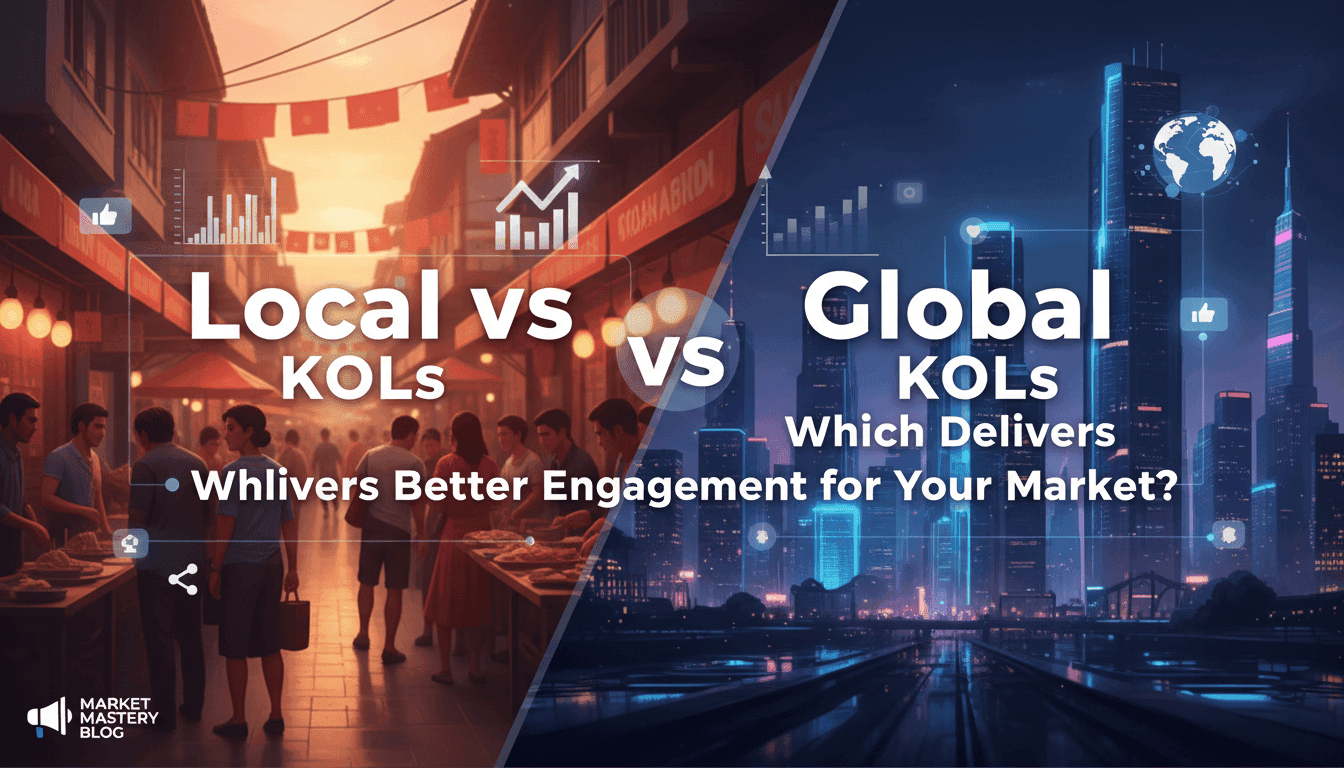
Table Of Contents
- Understanding the Local vs Global KOL Landscape
- What Defines a Local KOL vs a Global KOL?
- Engagement Metrics: The Real Story Behind the Numbers
- When Local KOLs Outperform Global Influencers
- The Case for Global KOLs: Scale and Prestige
- Market-Specific Considerations: Geography and Culture Matter
- Budget Allocation: Getting Maximum ROI from Your KOL Strategy
- How AI-Powered Discovery Changes the Local vs Global Decision
- Building a Hybrid Strategy That Combines Both Approaches
- Measuring Success: KPIs That Actually Matter
The influencer marketing landscape has evolved far beyond simple follower counts and vanity metrics. Today's marketers face a critical strategic decision: should they partner with local Key Opinion Leaders (KOLs) who deeply understand specific markets, or invest in global influencers with massive international reach? The answer isn't straightforward, and choosing incorrectly can mean the difference between a campaign that resonates authentically and one that falls flat despite impressive reach numbers.
This debate has intensified as brands expand into new markets, particularly in regions like Asia-Pacific where platforms like Xiaohongshu dominate alongside Instagram and TikTok. A global influencer might deliver millions of impressions, but a local KOL with 50,000 engaged followers could drive significantly higher conversion rates and brand affinity within your target market. The key lies in understanding not just the numbers, but the nuances of engagement, cultural alignment, and audience trust.
In this comprehensive guide, we'll examine the engagement performance of local versus global KOLs across different market scenarios, explore the factors that determine which approach works best for your brand, and provide a framework for making data-driven decisions. Whether you're launching a new product, entering a foreign market, or optimizing your existing influencer strategy, you'll discover how to identify creators who deliver genuine business results rather than just impressive follower counts.
Local vs Global KOLs
Which Delivers Better Engagement for Your Market?
When to Choose Local KOLs
Entering New Markets
Deep cultural understanding and trust within specific regions drives authentic engagement
High Conversion Goals
Local audiences show stronger purchase intent and trust creator recommendations
Budget-Conscious Campaigns
Better cost-per-engagement and ROI for market-specific objectives
When to Choose Global KOLs
International Brand Positioning
Build prestige and credibility across multiple markets simultaneously
Multi-Market Awareness
Efficient reach across geographies with consistent messaging
Premium Content Assets
Professional-grade content for multi-channel repurposing
💡 The Winning Strategy: Hybrid Approach
Most successful brands combine both for maximum impact
Ready to Find the Perfect KOLs?
Use AI to discover creators based on content quality and audience alignment—not just follower counts
Start Free DiscoveryUnderstanding the Local vs Global KOL Landscape
The influencer ecosystem has fragmented into distinct tiers, each serving different strategic purposes. Global KOLs typically command audiences across multiple countries and languages, often exceeding one million followers with content that transcends cultural boundaries. These creators have built international recognition through consistent, high-quality content that appeals to broad demographic segments. Local KOLs, conversely, have cultivated dedicated followings within specific geographic regions, cities, or cultural communities, typically ranging from 10,000 to 500,000 followers who share common cultural references, language nuances, and local interests.
This distinction goes deeper than geography alone. Local KOLs function as trusted community voices who understand regional preferences, cultural sensitivities, and local market dynamics in ways that global influencers simply cannot replicate. They speak the same dialect, reference local events, understand regional humor, and navigate cultural norms with native fluency. Global KOLs, meanwhile, offer aspirational appeal and international credibility that can elevate brand perception and create buzz across multiple markets simultaneously.
The platforms themselves have evolved to support both approaches. While Instagram and YouTube remain strongholds for global influencers, platforms like Xiaohongshu in China, regional TikTok communities, and local X (Twitter) influencers have created opportunities for hyper-local influence that didn't exist five years ago. Modern AI influencer discovery tools can now scan these diverse platforms simultaneously, identifying creators based on actual content quality and audience alignment rather than just follower counts.
The choice between local and global isn't always binary. Many successful brands employ tiered strategies that leverage global KOLs for brand awareness while relying on local creators for conversion and community building. Understanding this landscape requires moving beyond superficial metrics to examine engagement quality, audience demographics, and alignment with specific campaign objectives.
What Defines a Local KOL vs a Global KOL?
Defining these categories requires examining multiple dimensions beyond simple geography. A local KOL typically maintains at least 70% of their audience within a specific country, region, or metropolitan area. Their content references local landmarks, uses regional language or dialects, discusses local news and trends, and collaborates primarily with local brands. These creators often have stronger personal connections with their audience, frequently engaging in local events, meetups, and community activities that reinforce their local authority.
Global KOLs demonstrate distributed audience demographics across multiple countries, often with no single country representing more than 30-40% of their total following. Their content uses universally understood language (often English), focuses on globally relevant themes like fashion, technology, travel, or lifestyle, and features collaborations with international brands. These creators have typically achieved recognition through viral content, exceptional production quality, or unique expertise that transcends cultural boundaries.
However, these definitions have become more nuanced with platform evolution. A creator might be considered local on one platform while maintaining global reach on another. For instance, a fashion KOL might have predominantly local followers on Xiaohongshu while maintaining a more international audience on Instagram. This is where sophisticated influencer marketing platforms become essential, offering cross-platform analytics that reveal true audience distribution.
Another critical distinction lies in content approach. Local KOLs often create content in native languages with cultural specificity that doesn't always translate well internationally. They understand local shopping behaviors, payment preferences, and consumer pain points that global creators might miss. Global KOLs, meanwhile, develop content with intentional cultural neutrality or broad appeal, focusing on universal themes and production values that work across markets. Neither approach is inherently superior—the right choice depends entirely on your specific market objectives and target audience characteristics.
Engagement Metrics: The Real Story Behind the Numbers
When comparing local and global KOLs, raw engagement rates tell only part of the story. Research consistently shows that local KOLs typically achieve 3-8% engagement rates, significantly higher than the 1-3% average for global influencers. However, this metric alone doesn't capture the quality of that engagement or its business impact. A local KOL's comments section often features substantive questions about products, discussions about local availability, and genuine purchase intent signals that indicate high-value engagement.
Global KOLs compensate for lower engagement percentages through massive reach. While only 2% of a global influencer's audience might engage with a specific post, that 2% could represent hundreds of thousands of interactions across diverse markets. These campaigns excel at building broad brand awareness and establishing international credibility, particularly valuable for brands planning multi-market expansion or seeking to position themselves as global players.
The quality of engagement differs substantially between these categories. Local KOL audiences tend to trust recommendations more deeply because they perceive the creator as "one of them"—someone who understands their specific needs, challenges, and cultural context. This trust translates into higher conversion rates, with some studies showing local KOL campaigns achieving conversion rates 40-60% higher than equivalent global campaigns in the same market. The audience views product recommendations as coming from a trusted community member rather than a distant celebrity.
Modern AI marketing services can now analyze engagement quality beyond surface metrics, examining comment sentiment, question density, purchase intent signals, and audience authenticity. These tools reveal that a local KOL with 50,000 real, engaged followers often delivers superior ROI compared to a global influencer with 2 million followers but high bot percentages and disengaged audiences. The key is measuring engagement as a business outcome rather than just a vanity metric.
When Local KOLs Outperform Global Influencers
Specific market scenarios consistently favor local KOL strategies. Geographic expansion into new markets represents the clearest use case, where brands need to establish credibility and cultural understanding within a specific region. When entering markets with strong cultural identities—such as Japan, Korea, Southeast Asian countries, or specific European regions—local KOLs provide essential cultural translation that global influencers cannot replicate. They understand local shopping platforms, payment methods, regulatory considerations, and consumer behaviors that directly impact conversion.
Product categories with strong local preferences also benefit dramatically from local KOL partnerships. Food and beverage brands, beauty products that cater to specific skin tones or climate conditions, fashion that reflects local style preferences, and services that operate only in specific regions all perform better with local creator partnerships. A local food blogger who understands regional taste preferences and cooking methods will drive more authentic engagement than a global food influencer promoting the same product with generic messaging.
Campaigns requiring high conversion rates and direct response rather than just awareness consistently perform better with local KOLs. When your primary objective is driving immediate purchases, sign-ups, or foot traffic to physical locations, local creators deliver superior results. Their audiences are geographically accessible to your business, culturally primed to respond to the messaging, and more likely to trust specific product recommendations. This is particularly relevant for e-commerce brands using platforms like Xiaohongshu, where purchase intent is exceptionally high.
Budget-conscious campaigns often achieve better ROI with local KOLs. While global influencers command premium fees reflecting their international reach, local creators typically offer more accessible pricing with comparable or superior engagement within your target market. A well-structured campaign with 10-15 local micro-influencers can generate more meaningful business outcomes than a single global macro-influencer at similar total cost. Influencer marketing agencies increasingly recommend this distributed approach for clients seeking measurable business results rather than just brand visibility.
The Case for Global KOLs: Scale and Prestige
Global KOLs deliver unique advantages that local creators cannot match. International brand positioning represents perhaps the strongest case for global partnerships. When your brand strategy involves establishing international credibility or creating aspirational brand perception, association with globally recognized creators signals market leadership and quality. Luxury brands, technology companies, and lifestyle products often leverage global KOLs specifically for this prestige factor, knowing that endorsement from internationally recognized creators elevates brand perception.
Multi-market awareness campaigns benefit from global influencer efficiency. Rather than coordinating dozens of local KOL partnerships across different markets, a single global influencer campaign can generate awareness across multiple geographic regions simultaneously. This approach works particularly well for product launches, brand repositioning, or campaigns where consistent messaging across markets matters more than culturally specific adaptation. The coordination efficiency alone can justify the premium pricing that global KOLs command.
Content quality and production value often reaches higher levels with global KOLs who have professional teams, studio facilities, and refined content creation processes. These creators produce content that meets international production standards, suitable for repurposing across owned media channels, paid advertising, and retail environments. Brands frequently negotiate content rights that extend campaign value beyond the initial social media posts, using high-quality creator content across multiple marketing channels.
Global KOLs also excel in niche expertise categories where audience is distributed internationally rather than concentrated geographically. Technology reviewers, gaming influencers, certain B2B thought leaders, and specialized hobby communities often have naturally global audiences. For these categories, geographic proximity matters less than subject matter expertise and community recognition. A globally recognized tech reviewer on YouTube carries more weight than a local creator when launching a new gadget, regardless of market.
Market-Specific Considerations: Geography and Culture Matter
Different markets demonstrate varying receptiveness to local versus global influencer strategies. Asian markets, particularly China, Japan, and Korea, show strong preference for local KOLs due to cultural specificity and language nuances. Chinese consumers on platforms like Xiaohongshu expect content in Mandarin with local cultural references, and global influencers rarely achieve the same trust levels as local creators who understand regional preferences. Xiaohongshu marketing campaigns overwhelmingly rely on local KOLs for this reason.
Western markets including North America and Western Europe demonstrate more balanced receptiveness to both approaches. English-language content crosses borders more easily, and consumers in these markets have grown accustomed to following international creators. However, even within these regions, local creators often outperform for products with geographic limitations or strong cultural components. A local food blogger in Texas will drive more authentic engagement for a regional restaurant chain than a national food influencer, despite the latter's larger following.
Emerging markets in Southeast Asia, Latin America, Africa, and Eastern Europe often present the strongest case for local KOL strategies. These markets feature rapidly growing social media adoption, strong local language preferences, and audiences that value community connection over celebrity association. Brands entering these markets consistently achieve better results by partnering with local creators who understand the unique characteristics of each market rather than assuming global strategies will translate directly.
Platform dominance varies significantly by geography, affecting KOL strategy. While Instagram and TikTok have global reach, regional platforms like Xiaohongshu in China, LINE in Japan and Thailand, and VK in Russia require local creator partnerships simply due to platform accessibility. Content marketing strategies must account for these platform variations, often necessitating different creator strategies for different markets even within the same campaign.
Budget Allocation: Getting Maximum ROI from Your KOL Strategy
Budget considerations fundamentally shape the local versus global decision. Cost per engagement metrics consistently favor local KOLs, particularly in the micro and mid-tier categories. A local creator with 50,000 followers might charge $500-2,000 per post while generating 3,000-4,000 engaged interactions, resulting in a cost per engagement of $0.13-0.67. A global influencer with 2 million followers might charge $15,000-30,000 while generating 40,000-60,000 interactions, resulting in a cost per engagement of $0.25-0.75, often with lower conversion quality.
However, coordination costs must factor into these calculations. Managing relationships with 20 local KOLs across different markets requires more time, communication, and oversight than managing a single global influencer partnership. Brands without dedicated influencer marketing agency support or robust internal teams may find the operational efficiency of global partnerships justifies the premium pricing.
Content rights and usage present another budget consideration. Global KOLs typically command higher fees for content licensing beyond the initial social posts, but that content often delivers more versatile value for use in paid advertising, retail displays, and owned media channels. Local KOL content, while potentially more culturally authentic, may have limited applicability outside the specific market and platform for which it was created.
Smart budget allocation often involves tiered strategies that combine both approaches based on campaign objectives. A typical allocation might dedicate 60-70% of budget to local KOLs for conversion and community building, while reserving 30-40% for strategic global partnerships that provide content assets, prestige, and broad awareness. This balanced approach maximizes both reach and relevance, particularly for brands operating across multiple markets simultaneously.
How AI-Powered Discovery Changes the Local vs Global Decision
Traditional influencer discovery methods created artificial barriers between local and global KOL strategies. Brands relied on manual searches, agency recommendations, or static databases that categorized creators by follower count and location but missed crucial performance indicators. AI influencer discovery fundamentally changes this paradigm by enabling real-time analysis across platforms and geographies simultaneously, revealing creators whose content quality and audience alignment match campaign objectives regardless of their local or global classification.
Modern AI systems can process campaign briefs in plain English—"find fashion creators in Singapore who focus on sustainable style with audiences aged 25-35"—and scan Instagram, TikTok, YouTube, X, and Xiaohongshu simultaneously to surface relevant creators. This capability eliminates the false choice between local and global strategies by identifying optimal creators based on actual performance metrics rather than predetermined categories. The technology evaluates content quality, audience engagement patterns, brand value alignment, and authenticity signals that traditional discovery methods miss entirely.
Real-time platform scanning reveals creators who might appear local on one platform while maintaining broader reach on others, enabling more sophisticated multi-platform strategies. A creator might have strong local influence on Xiaohongshu while maintaining complementary international presence on Instagram, offering opportunities for coordinated campaigns that leverage both local authenticity and broader reach. AI SEO agents and discovery tools surface these nuanced insights that manual research would require weeks to uncover.
AI-powered analytics also transform performance prediction, using historical campaign data to estimate likely engagement and conversion rates before committing budget. Rather than choosing between local and global based on assumptions, brands can model expected outcomes for different creator combinations, optimizing budget allocation based on predicted ROI. This data-driven approach reduces risk and enables more confident investment in creator partnerships that deliver measurable business results.
Building a Hybrid Strategy That Combines Both Approaches
The most sophisticated brands recognize that local versus global isn't an either-or decision but rather a strategic allocation question. Hybrid strategies leverage global KOLs for specific objectives like broad awareness, content creation, and brand prestige while simultaneously deploying local creators for market-specific conversion, community building, and cultural authenticity. This layered approach captures advantages from both categories while mitigating their respective limitations.
A typical hybrid structure might begin with a global brand ambassador who creates hero content, establishes international credibility, and generates awareness across multiple markets. This partnership provides high-quality content assets suitable for paid amplification and owned media use. Simultaneously, the brand partners with 30-50 local micro and mid-tier KOLs across target markets who adapt messaging to local contexts, drive conversions, and build genuine community connections within their specific regions.
Sequential campaigns represent another hybrid approach, where global KOL partnerships establish initial awareness followed by local creator activations that drive deeper engagement and conversion. For product launches, a global influencer might announce the product to international audiences, creating buzz and establishing market presence. Local KOLs then provide detailed reviews, local availability information, and culturally specific use cases that convert awareness into purchases within their respective markets.
The key to successful hybrid strategies lies in coordinated messaging with cultural flexibility. Global and local creators should reinforce consistent brand values and product benefits while adapting expression to their specific audiences. A social media agency with cross-market experience can ensure this balance, maintaining brand coherence while enabling the cultural authenticity that makes local partnerships effective. Technology platforms that provide unified campaign management across creator tiers streamline execution and measurement of these complex hybrid approaches.
Measuring Success: KPIs That Actually Matter
Effective measurement separates high-performing KOL strategies from vanity metric exercises. For local KOL campaigns, focus on conversion-oriented KPIs including click-through rates to product pages, coupon code redemptions, direct sales attribution, foot traffic to physical locations, and local brand search volume increases. These metrics directly connect creator partnerships to business outcomes rather than just engagement numbers. Local campaigns should demonstrate measurable impact on regional sales, market share, or customer acquisition within specific geographies.
Global KOL campaigns require different success metrics aligned with awareness and positioning objectives. Track reach across target markets, brand mention volume, share of voice versus competitors, content engagement quality (comments asking substantive questions rather than just emojis), and brand perception shifts measured through surveys. Monitor how global partnerships contribute to international recognition, press coverage, and market entry facilitation in new geographies.
Both approaches should measure audience quality metrics including follower authenticity percentages, engagement rate consistency over time, audience demographic alignment with target customers, and audience purchasing power indicators. An influencer marketing platform with advanced analytics can surface these insights, revealing whether apparent engagement comes from real potential customers or bot accounts and disengaged followers.
Long-term value metrics matter increasingly as brands shift from one-off campaigns to ongoing creator partnerships. Track how repeated collaborations with specific creators impact customer lifetime value, retention rates, and community sentiment over time. The most valuable creator relationships compound their impact through sustained authenticity and audience trust that builds with each collaboration, delivering superior ROI compared to constantly rotating creator partnerships.
Ultimately, the local versus global decision should align with specific, measurable business objectives. Brands seeking rapid market penetration in new geographies will weight local KOL performance heavily. Those building international brand equity will value global partnerships differently. The key is establishing clear KPIs before campaign launch and rigorously measuring performance against those specific objectives rather than generic engagement benchmarks.
The local versus global KOL debate doesn't have a universal answer because it asks the wrong question. The right question is: which creator characteristics, audience attributes, and engagement patterns will drive your specific business objectives within your target markets? Sometimes that means local KOLs with deep community connections and cultural fluency. Other times it means global influencers with international credibility and massive reach. Most often, it means a strategic combination of both, carefully orchestrated to maximize different aspects of your marketing objectives.
The evolution of AI-powered discovery tools has fundamentally changed how brands should approach this decision. Rather than choosing between predetermined categories, modern technology enables precise identification of creators whose content quality, audience engagement, and brand alignment match your specific needs, regardless of whether they classify as local or global. This capability transforms influencer marketing from an art based on intuition and relationships into a science driven by data and measurable outcomes.
As you develop your influencer strategy, focus less on the local-global dichotomy and more on authentic alignment between creator audiences and your target customers. Prioritize engagement quality over quantity, conversion potential over vanity metrics, and cultural resonance over raw reach. Whether working with neighborhood micro-influencers or international celebrities, success ultimately comes from genuine connections between creators, their audiences, and your brand values. The most effective strategies recognize that in today's fragmented media landscape, the creator who truly understands and connects with your specific customer will always outperform the one with just the biggest following.
Ready to Find the Perfect KOLs for Your Market?
Stop guessing which creators will actually drive results for your brand. StarScout AI scans Instagram, TikTok, YouTube, X, Xiaohongshu and other platforms in real time to find local and global creators whose audiences genuinely align with your target market. Tell us your goals in plain English, and our AI engine surfaces creators based on content quality, engagement authenticity, and brand value alignment—not just follower counts.
Discover creators who deliver real business results. Start your free discovery today and see how AI-powered influencer matching transforms your marketing ROI.