
Japan KOL vs Western Influencers: Key Cultural Differences Every Marketer Should Know
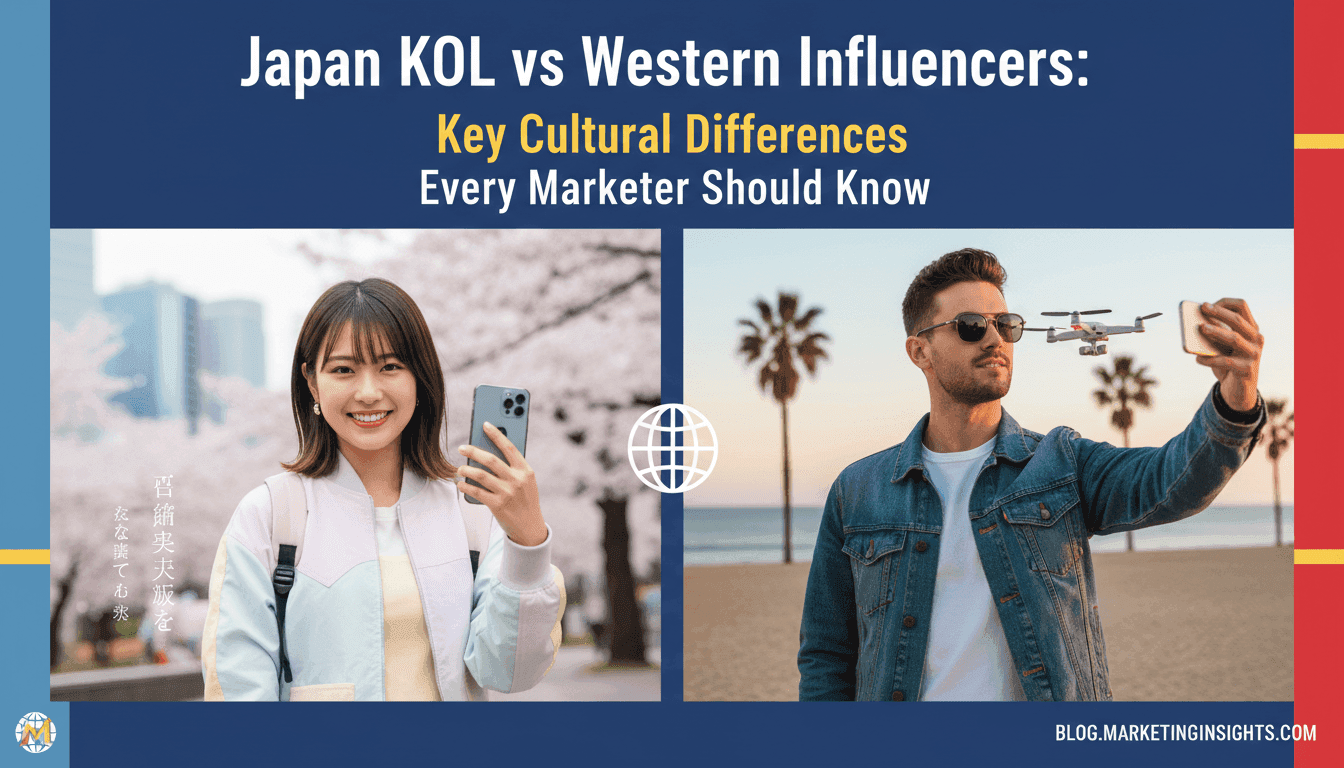
Table Of Contents
- Why the Japan vs. Western Influencer Divide Matters
- How Influence Is Earned Differently in Japan
- Content Style: Authenticity Has Different Definitions
- Audience Expectations and Engagement Patterns
- Platform Preferences: Where KOLs and Influencers Actually Live
- Brand Relationships and Campaign Collaboration
- Disclosure, Trust, and the Commercialization of Influence
- What This Means for Your Influencer Strategy
- Finding the Right KOL or Influencer for Any Market
Japan KOL vs Western Influencers: Key Cultural Differences Every Marketer Should Know
When a global brand decides to expand its influencer marketing into Japan, the instinct is often to replicate what works in Western markets. Find someone with a large following, brief them on the product, and let the content roll out. But that approach almost always underperforms — and sometimes fails outright — because the rules governing influence, trust, and creator-audience relationships in Japan are fundamentally different from those in the United States, the UK, or Australia.
Understanding the contrast between Japanese KOLs (Key Opinion Leaders) and Western influencers is not just an exercise in cultural appreciation. It is a practical marketing necessity. The way creators build credibility, the type of content that resonates, the platforms audiences prefer, and the unspoken expectations between brands and creators all differ significantly across these markets. Get it right, and your campaign taps into deep consumer trust. Get it wrong, and even a well-funded effort can feel tone-deaf to a Japanese audience.
This article breaks down the most important cultural differences between Japan KOLs and Western influencers — from content philosophy and engagement dynamics to platform behavior and brand collaboration norms — so you can build smarter, more culturally intelligent influencer campaigns.
Why the Japan vs. Western Influencer Divide Matters {#why-it-matters}
Influencer marketing is often discussed as if it were a universal discipline — plug in a creator, attach a product, and generate awareness. The reality is far more nuanced, especially when comparing Japan with Western markets like the US, UK, or Canada. Japan's media culture, consumer psychology, and social norms create a completely different environment for creators and their audiences.
Japanese consumers are among the most discerning in the world. They tend to research purchases extensively, place high value on quality and craftsmanship, and are deeply skeptical of overt sales tactics. This shapes everything about how effective KOLs operate in Japan. Western influencer culture, by contrast, has evolved in a media environment where directness, bold self-expression, and visible aspiration are rewarded. These are not better or worse approaches — they are responses to entirely different cultural landscapes.
For brands running multi-market campaigns or entering Japan for the first time, understanding these differences is the difference between a campaign that converts and one that quietly gets ignored.
How Influence Is Earned Differently in Japan {#how-influence-is-earned}
In Western markets, influence is often built on personality and relatability. Creators who share their personal lives, voice strong opinions, or project an aspirational lifestyle tend to attract large followings quickly. The more distinctive the personal brand, the more shareable the content.
In Japan, influence tends to be earned through demonstrated expertise, consistency, and a sense of refined taste. Japanese KOLs often build their authority over longer periods by being recognized as knowledgeable and trustworthy within a specific domain — beauty, food, fashion, travel, or technology. The emphasis is less on the creator's personality as entertainment and more on the creator's judgment as a reliable reference point.
This distinction has real implications for campaign selection. A Western micro-influencer with strong engagement around a lifestyle niche may have built that following through humor or personal storytelling. A Japanese KOL with similar reach may have built it through meticulous, detail-rich content about a single category. Both can be effective — but they signal very different things to their respective audiences.
Content Style: Authenticity Has Different Definitions {#content-style}
One of the most important — and most misunderstood — differences between Japanese KOLs and Western influencers lies in how each culture defines authenticity.
In Western influencer culture, authenticity often means rawness. Unfiltered opinions, behind-the-scenes glimpses, spontaneous moments, and even visible imperfections are valued because they signal that the creator is being real rather than performing. This is why "deinfluencing" trends, honest reviews, and "no-filter" aesthetics have gained traction in markets like the US.
In Japan, authenticity takes a different form. It is expressed through care, precision, and restraint. A Japanese KOL who spends significant time testing a skincare product and produces a thorough, calm, and visually composed review is considered more trustworthy — not less — than someone who delivers an off-the-cuff reaction. Excessive enthusiasm or overtly promotional energy is actually a red flag for Japanese audiences, who may interpret it as inauthenticity or pressure selling.
Content aesthetics also differ significantly. Japanese creator content tends to favor clean composition, attention to detail, and visual harmony — an influence of broader Japanese design philosophy. Western content, particularly on platforms like TikTok, often prioritizes energy, motion, and immediate hooks. Brands adapting content for the Japanese market often need to slow down, refine, and strip out the urgency that works so well elsewhere.
Audience Expectations and Engagement Patterns {#audience-expectations}
Engagement metrics look different across these two markets, and misreading them can lead to poor creator selection decisions.
Western influencer audiences are often vocal. Comments sections on Instagram or TikTok posts frequently contain debates, questions, enthusiastic reactions, and even criticism. High comment volume and shares are seen as strong indicators of audience connection. Brands and platforms in Western markets have become very comfortable using these visible signals to assess creator performance.
Japanese social media audiences are comparatively quieter. It is common for followers to read, absorb, and act on content without leaving a public comment. This is partly a reflection of Japan's broader cultural norms around public expression and social harmony — stating strong opinions in public spaces, even digital ones, can feel uncomfortable. This means that low comment counts do not necessarily signal low engagement or poor influencer performance in Japan.
For marketers using influencer marketing platforms or analytics tools, this is a critical nuance. Measuring Japanese KOL effectiveness requires looking beyond raw comment numbers and examining metrics like saves, repeat visits, follower growth rate, and conversion signals. Applying Western engagement benchmarks to Japanese creator performance will almost always produce a misleading picture.
Platform Preferences: Where KOLs and Influencers Actually Live {#platform-preferences}
Western influencer culture is dominated by Instagram, TikTok, YouTube, and — depending on the niche — X (formerly Twitter). These platforms reward discoverability, viral content, and broad audience growth. Creators on these platforms often operate across multiple channels simultaneously, building cross-platform presences.
Japan's social media landscape has some overlap but important differences. Instagram is widely used, particularly for fashion, beauty, food, and travel content. YouTube has a strong presence for longer-form creator content. However, Japan also has high engagement on platforms that receive less international attention, including X (Japan remains one of the most active X markets in the world), LINE (Japan's dominant messaging platform), and historically, platforms like Niconico for video content.
For brands targeting pan-Asian or East Asian markets, it is also worth noting the role of platforms like Xiaohongshu (RedNote), which bridges Chinese and Japanese consumer culture and hosts a significant volume of lifestyle and beauty content relevant to Japanese-speaking and Chinese-speaking audiences simultaneously.
An effective Japan influencer strategy requires platform knowledge that goes beyond simply assuming that what works on TikTok in Los Angeles will translate to Tokyo.
Brand Relationships and Campaign Collaboration {#brand-relationships}
The working relationship between brands and creators is structured quite differently in Japan compared to Western markets.
In Western influencer marketing, creators frequently negotiate their own deals, work with talent agencies, and operate with a high degree of creative autonomy. It is standard for a brand to brief a creator and then largely step back, trusting the creator's instinct for what their audience wants. Creators who push back on excessive brand control are often celebrated for protecting their authenticity.
In Japan, the brand-creator relationship tends to be more formal, more deferential, and more collaborative in a structured sense. Japanese KOLs often work through agencies or management companies, and campaigns involve more detailed communication, clearer approval processes, and a closer alignment with brand messaging. This is not creative restriction so much as a reflection of Japan's broader professional culture, which values precision, responsibility, and mutual respect in business relationships.
For international brands used to the informal, fast-moving nature of Western influencer campaigns, working with Japanese KOLs requires adjusting timelines, communication styles, and approval workflows. Rushing the process or expecting rapid turnarounds can damage the relationship before it begins.
Disclosure, Trust, and the Commercialization of Influence {#disclosure-and-trust}
Sponsorship disclosure norms are evolving in both markets, but the underlying attitudes toward commercial content differ considerably.
In Western markets, the FTC and equivalent bodies in the UK and Australia have pushed for clear disclosure of paid partnerships. Western audiences have largely adapted to this reality and — when creators they trust recommend a product — can accept sponsored content as legitimate if the creator's enthusiasm seems genuine. The relationship between creator and brand has become relatively normalized and visible.
In Japan, the commercialization of creator content is a more sensitive area. Japanese consumers place very high value on editorial independence, and there has historically been more discomfort around overt advertising through personal channels. Japan introduced stricter influencer disclosure rules more recently, and audiences are increasingly aware of paid content. However, the expectation in Japan is that sponsored content should be approached with the same care and thoughtfulness as organic content — the moment a post feels like an advertisement rather than a recommendation, trust erodes quickly.
This makes product seeding, long-term brand partnerships, and genuine creator buy-in especially important in Japan. A KOL who genuinely uses and believes in a product will communicate that in a way that Japanese audiences recognize and respond to.
What This Means for Your Influencer Strategy {#what-this-means}
Running influencer campaigns across both Japan and Western markets is entirely achievable, but it requires building two distinct strategic frameworks rather than adapting a single global approach.
For Western markets, you can lean into personality-driven discovery, broad engagement metrics, platform-native formats like Reels and TikToks, and relatively rapid campaign cycles. For Japan, the priority should be finding KOLs with deep category credibility, designing content that respects the audience's intelligence and aesthetic expectations, allowing more time for relationship-building with creators, and measuring success through metrics that account for quieter but meaningful audience behavior.
Brands that invest in this dual-track thinking tend to see significantly stronger results in both markets. Those that try to force a unified template often find their Japan campaigns underperforming with no clear understanding of why.
This is also where influencer marketing agency support becomes particularly valuable — especially from teams with direct experience in both cultural contexts.
Finding the Right KOL or Influencer for Any Market {#finding-the-right-kol}
Knowing the cultural differences is only half the equation. The other half is having the tools to act on that knowledge efficiently.
Traditional influencer databases are built around static search filters — follower count, category tags, platform. They struggle to account for the nuanced, culturally specific signals that determine whether a creator is a good fit for a Japanese campaign versus a Western one. A creator might pass every standard filter and still be completely wrong for a Tokyo audience.
This is where AI influencer discovery changes the game. Instead of filtering through databases, StarScout AI allows marketers to describe what they are looking for in plain language — specifying not just category or follower count but the tone, content quality, audience values, and cultural alignment they need. The AI engine scans Instagram, TikTok, YouTube, X, Xiaohongshu, and other networks in real time, surfacing creators whose actual content and audience behavior match the brief.
For brands navigating the Japan versus Western influencer landscape, this means being able to find a Japanese beauty KOL with the right aesthetic sensibility and audience trust signals just as easily as finding a high-energy Western lifestyle creator — without needing two separate vendor relationships or two entirely different research processes.
The Cultural Gap Is Real — But Navigable
The differences between Japan KOLs and Western influencers are not superficial. They run through every layer of how influence is built, how content is created, how audiences engage, and how brands should collaborate with creators. Marketers who treat these markets as interchangeable will consistently underperform. Those who take the time to understand and respect these differences will find that Japanese audiences are extraordinarily loyal and responsive when approached correctly.
The good news is that cultural intelligence and smart technology are no longer mutually exclusive. With the right understanding of each market and the right tools to identify creators who genuinely fit your brand's goals, running effective influencer campaigns in Japan and Western markets simultaneously is well within reach. The key is knowing what you are looking for — and having a system smart enough to find it.
Ready to Find the Right Influencers Across Any Market?
StarScout AI is an always-on AI influencer discovery engine that understands your brief in plain English and scans Instagram, TikTok, YouTube, X, Xiaohongshu, and more in real time — surfacing creators whose content, audience, and values genuinely align with your campaign goals.
Stop guessing. Start finding. Try StarScout AI today.